
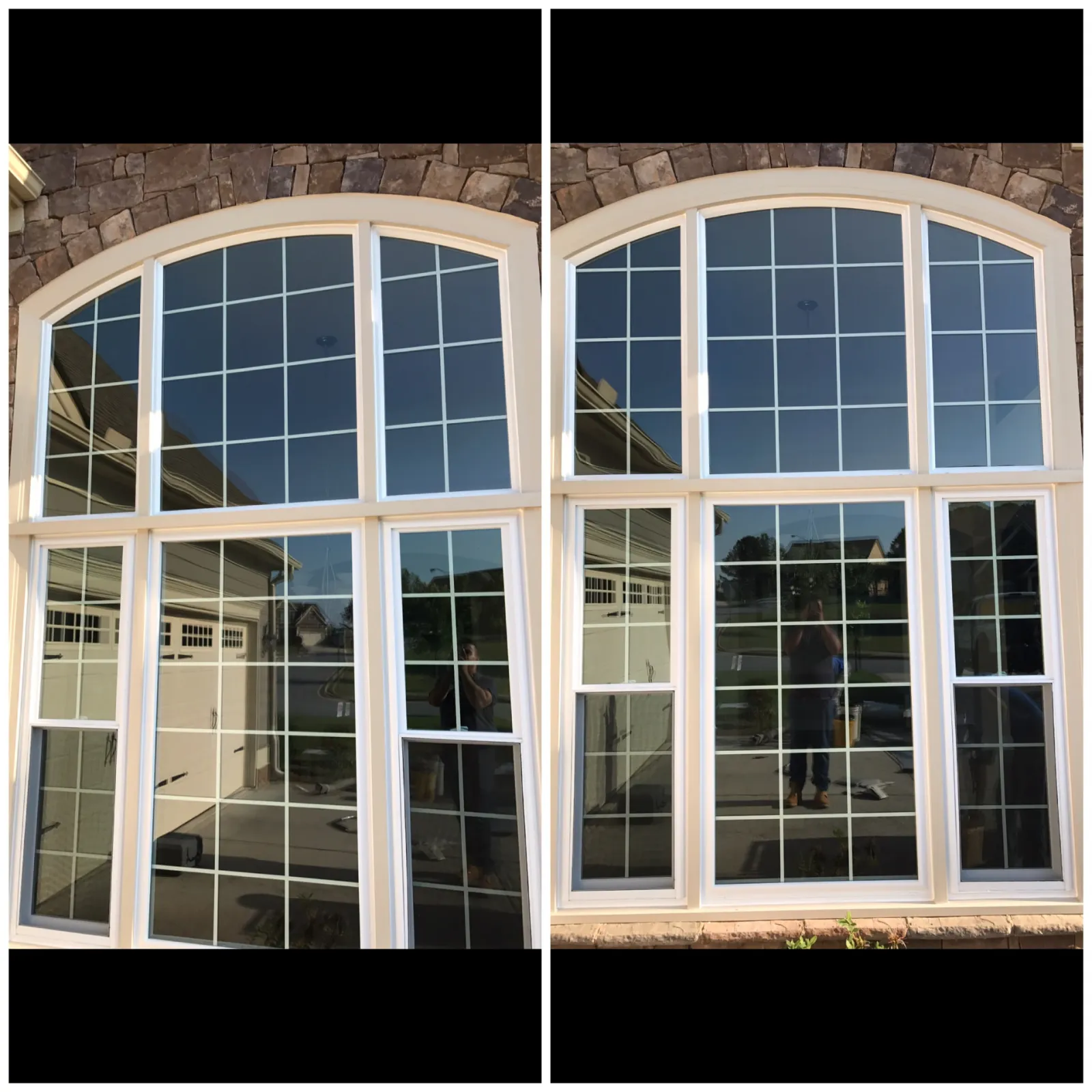
The photo above is an arched two story window on a Lawrenceville area home with a stone surround. On the left, the trim and the joints around the arch had aged and the mullion lines were tired. On the right, everything is rebuilt, sealed and painted a clean white that lines up with the window frames.
Arched and specialty windows, meaning arches, half rounds, transoms, octagons and trapezoids, are what make a two story foyer or great room elevation look custom. They are also the trim on your house most likely to fail first, and the least likely to be inspected because it is twenty feet in the air.
Why the curve is the problem
Water management depends on surfaces that shed. A curve does neither well:
- No consistent slope. The top of the arch sheds fine. As the curve turns down toward vertical, water starts running along the trim instead of off it.
- The springline. Where the arch meets the straight leg, everything that ran along the curve arrives at once. That joint takes many times more water than any other joint on the window.
- More joints per foot. Arched trim is either heat formed or built from segments. Segments mean joints, and joints mean sealant, and sealant has a service life.
- Difficult flashing. Head flashing on a straight window is a simple bent piece of metal. On an arch it has to be formed, and a lot of installers substituted sealant instead.
Add Georgia's driving summer rain and long humid stretches and you get failure at the springline eight to fifteen years in, no matter how good the paint was.
What we look for on an inspection
From a ladder or a lift, close up, we check:
- 1.Springline joints on both sides with a screwdriver. This is the first failure point on nearly every arched window we see.
- 2.The keystone or crown area at the top of the arch, especially where trim meets a stone or brick surround.
- 3.The sill and bottom corners of the unit below the arch, where water that ran down the glass collects.
- 4.Whether head flashing exists at all, or whether the joint above the trim is nothing but a bead of caulk.
- 5.Glass condition. Fogging, haze or a visible film between panes means the insulated glass seal has failed. That is a window replacement conversation, not a trim conversation, and it should happen before painting.
How we repair it
Cut back to solid material. Soft segments come out entirely. On arches we replace full segments rather than piecing in short patches, because a joint added in the middle of a curve becomes the next failure point.
Replace with material that cannot rot. Cellular PVC is our default for arched trim. It can be formed to the radius, it takes paint well when prepped, and it will not decay at the springline where water lives. Fiber cement works for flat bands and wide trim, with every field cut sealed.
Form real head flashing. Where none existed, we fabricate flashing that follows the arch and turns up behind the wall cladding or into a reglet on stone and stucco, so gravity does the work instead of sealant.
Seal the right joints and leave the drainage joints open. Vertical and overhead joints get a quality elastomeric sealant properly sized with backer rod where the gap warrants it. The bottom of the assembly stays open so water can weep out.
Prime and paint properly. Every bare and repaired surface gets primed, and dark colors on PVC get a paint formulated for PVC because thermal movement matters. Then two coats of quality exterior acrylic from our painting crew.
The look, which is half the reason people call
On the after photo, the trim white matches the window frames exactly and the reveals are consistent around the whole arch. That consistency is what makes an arched window read as architecture rather than as a repair. Details we pay attention to:
- Uniform trim width around the entire curve, so the shadow line does not wander.
- Clean transition where the trim meets a stone or brick surround, with the sealant joint tooled, not smeared.
- Matching the trim color across the elevation, including shutters and accessories and gable vents, so the front of the house reads intentional.
Combining it with other exterior work
Arched windows are almost always high, which means access equipment. If you are going to pay for access, use it. Homeowners routinely combine arched trim repair with:
- Fascia, rake board and soffit repairs at the same height, which is rot repair work that is otherwise awkward to schedule.
- Seamless gutter replacement or gutter guard installation, since we are already staged up there.
- A roof replacement if the roof is within a few years of the end of its life.
- Whole house painting, where the arched elevation is usually the hardest and most expensive part of the job to do on its own.
Bundling saves real money on setup and mobilization, not just a discount on paper.
Lawrenceville and Buford specifics
Two story arched foyer windows are everywhere in the subdivisions built around Lawrenceville, Buford, Dacula, Suwanee and Grayson from the mid 1990s through the 2000s. That housing stock is now twenty to thirty years old, which is precisely the window where two things happen at once: the original trim reaches the end of its life and the original insulated glass units start losing their seals.
If you are in that age of home and you have not looked closely at your arched window, look this month. From the ground with a phone camera zoom you can usually see paint failure at the springline and any dark staining under the arch.
Working with EZY Exteriors
Family owned, licensed and insured, over twenty five years of exterior work in North Georgia. Written scope before we begin, photos of what we find at height so you can see it without climbing, daily cleanup, a workmanship warranty on top of manufacturer coverage, and financing available.
If your arched window trim is peeling, soft at the corners or you simply cannot tell from the ground, get a written estimate and we will get eyes on it up close and tell you exactly what it needs.