
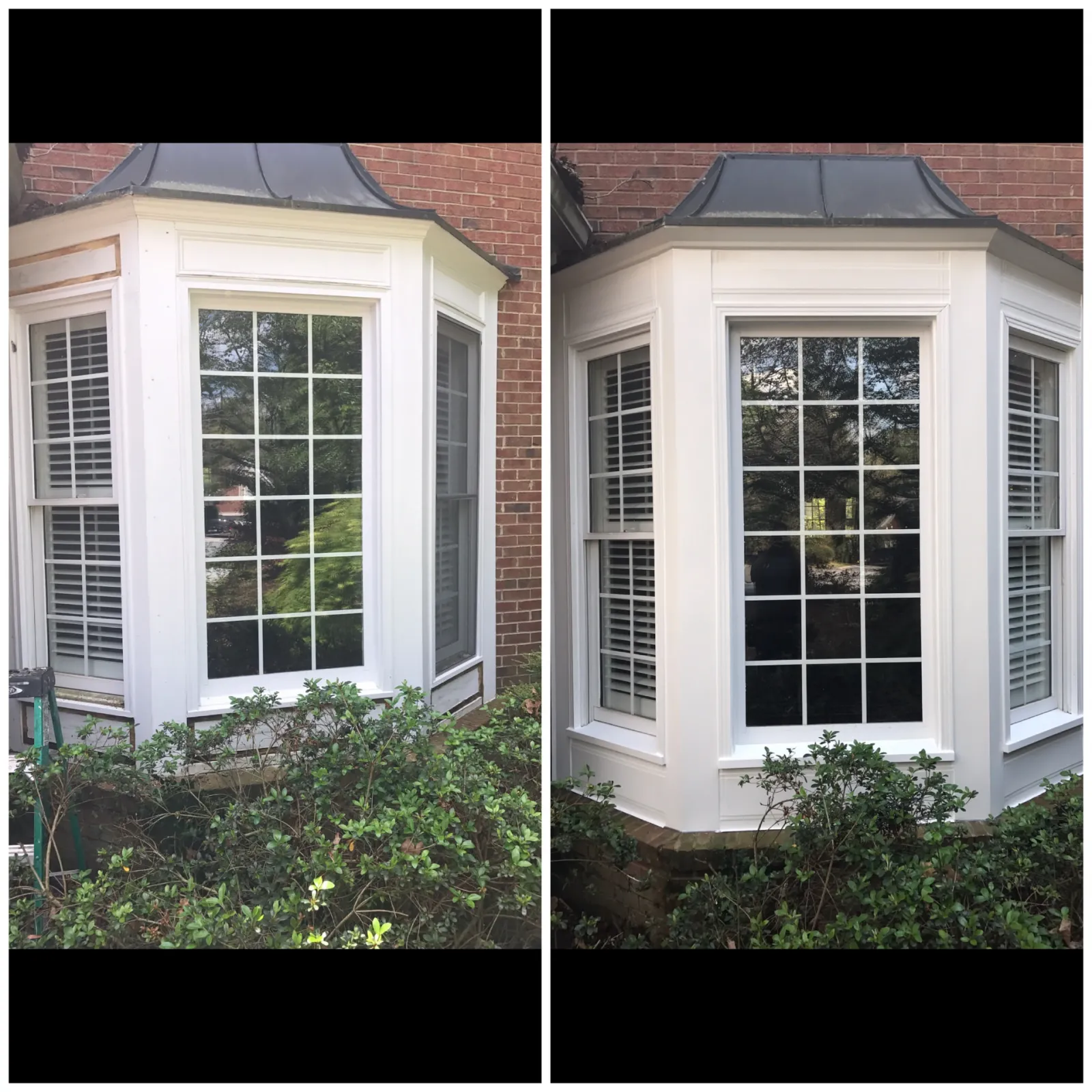
Look at the before and after above. Same brick home in the Lawrenceville area, same black metal bay window cap, same window units. The only thing that changed is the trim, and the difference in how the house reads is dramatic. On the left, the trim at the top left corner is stripped back to bare wood and the joints are tired. On the right the whole assembly is crisp, tight and white.
Brick homes are supposed to be low maintenance, and mostly they are. The trim is the exception, and it fails for reasons that surprise homeowners.
Why the wood next to your brick is the first thing to go
Brick and mortar behave like a sponge with a slow release valve. They soak up rainwater and hold it, then give it back over hours or days. Any wood in contact with that surface never fully dries out between storms in a Georgia summer.
Add the way most trim was installed on 1980s and 1990s homes in Gwinnett County:
- Trim installed tight to masonry with no gap and no drainage.
- The back and the cut ends left unprimed.
- Joints sealed with caulk that has a ten year life on a house that is thirty five years old.
- No head flashing above the trim, so water running down the brick face gets a chance to enter the top of the joint.
The wood decays from the back and the ends outward. By the time the paint blisters, the fiber is already soft.
The pattern we see on Lawrenceville brick homes
We probe the same five locations on every brick home:
- 1.Bottom corners of window trim, where water stands on the sill.
- 2.The trim leg that touches brick, especially on north facing walls that stay shaded and damp.
- 3.Fascia behind gutters, which is a gutter problem more often than a wood problem. If your fascia peels in long strips, look at the gutters.
- 4.Garage door jambs, which sit at splash height.
- 5.Rake and gable trim, high and never inspected.
If three of those are soft, the whole trim package is at the end of its life and spot repairs will chase you around the house for years.
What we replace it with
Cellular PVC for anything touching masonry, anything at the bottom of an assembly and anything within a foot of a roofline. It does not absorb water, it cannot rot and it holds paint well when prepped correctly.
Fiber cement trim for larger flat boards, wide bands and anywhere a homeowner wants the texture and weight of real wood. Every field cut gets sealed, and butt joints get flashed behind them rather than only caulked. That is standard practice on our fiber cement siding work and it applies to trim too.
Real head flashing above trim where the original had none, so water that runs down the brick sheds out over the top of the trim instead of into it.
Correct sealant, in the right joints only. Vertical joints get sealed. Bottom edges stay open so the assembly can drain. Sealing everything is how you build a bathtub in your wall.
The detail that makes a brick trim job look expensive
Reveals and proportions. On the after photo, the trim is set so the shadow lines are consistent all the way around the bay, and the corner joints are tight and mitered rather than butted with a caulk gap. Two extra hours per window in layout is the difference between a trim job that looks like a repair and one that looks like an upgrade.
We also match the trim white to the window frames and, when the homeowner wants it, carry that same white onto the shutters, gable vents and accessories so the whole elevation reads intentional.
Metal caps on brick bays
The bay in the photo has a black metal cap. Those caps typically outlast the wood and flashing underneath them by decades, so when we rebuild trim on a brick bay we also check:
- Whether the cap's flashing turns up behind or into the brick with a proper counterflashing detail, or whether somebody used sealant.
- Whether debris is holding water at the cap to wall junction.
- Whether the sheathing under the low pitch section is still solid.
When a cap needs work, our roofing crew handles it in the same mobilization instead of you booking a second contractor later.
Painting the trim on a brick home
Trim is the only paintable surface on many brick houses, which makes it the highest leverage cosmetic change you can make. Our painting crews prep to the same standard we would on a full body repaint: wash, scrape, sand, prime bare and repaired material, correct caulk, then two topcoats. On brick homes we also mask carefully, because paint splatter on brick is far harder to correct than on siding.
Popular direction in Lawrenceville, Buford and Suwanee right now: bright white trim with black or dark bronze window sashes and shutters against red or brown brick. It modernizes a dated elevation without touching the masonry.
Repair versus a full trim package
Our guidance to homeowners:
- Spot repair if you have one or two soft corners and the rest of the trim probes solid and holds paint.
- Full trim replacement in PVC if you are repainting anyway, if you have found rot on multiple elevations, or if you plan to stay in the home ten or more years. It costs more once and then stops costing anything.
Homes we trim out in PVC do not come back for trim work. That is the entire point.
Working with us
EZY Exteriors is family owned, licensed and insured, with over twenty five years of exterior work across Gwinnett County and North Georgia. You get a written scope, photos of anything we uncover, daily cleanup, a workmanship warranty alongside manufacturer coverage and financing options if the project is larger than planned.
If the trim on your brick home is soft, peeling or just tired, get a written estimate and we will probe every window and give you a straight answer about what needs replacing and what does not.