
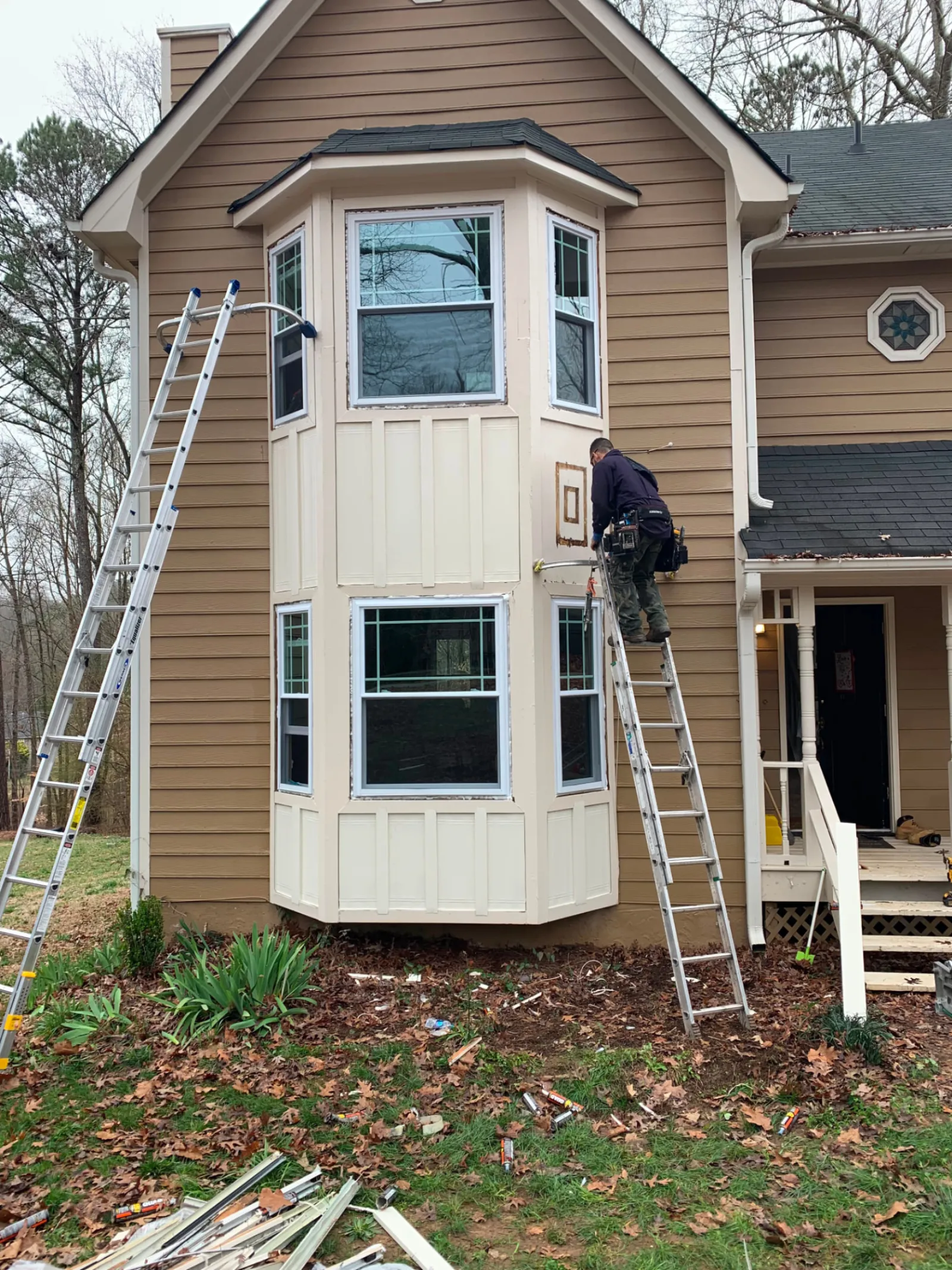
The photo above is a working shot, not a finished one: one of our crew on a ladder mid project, trim opened up, ladders on both sides of a bay tower. That in between stage is where an exterior paint job is actually won or lost. By the time the sprayer comes out, the outcome is already decided.
Homeowners in Lawrenceville call us regularly because trim they paid to have painted three years ago is peeling again. Almost every time, the paint was fine. The prep was not, or nobody addressed the water that kept arriving at the same joint.
Why trim paint fails around Gwinnett County
Four causes account for nearly everything we see:
- 1.Painting over failed caulk. New caulk on top of dried, cracked caulk moves and splits at the same place within a season.
- 2.Painting over damp or soft wood. Wood needs to be dry, ideally under about fifteen percent moisture content. Fresh paint on damp wood blisters from behind.
- 3.Skipping primer on bare and repaired areas. Topcoat is not designed to bond to raw wood, filler or chalky old paint.
- 4.Never fixing the leak. If head flashing is missing, or a gutter overflows onto the fascia, the wall gets wet after every storm no matter what is on the surface.
That last one is the important one. Paint is the last layer of a water management system. If the system is broken, paint is a cosmetic delay.
The prep sequence we follow
Wash and let it dry. Controlled pressure, a cleaner that kills mildew, then real dry time. On a humid Georgia week that can be a full day or more, and it is not optional.
Scrape, sand and feather edges. Loose and peeling film comes off. Hard edges get sanded so the new coating does not telegraph every old chip.
Probe every joint and corner. Screwdriver into bottom trim corners, sills, fascia behind the gutters, rake boards and the bottom siding courses. Anything soft is a repair, and that work happens before a drop of paint goes on. That is rotted wood and trim repair, and on many homes it is a quarter of the project.
Cut out failed caulk and re-caulk correctly. Vertical trim to siding joints get a quality elastomeric sealant sized for the gap, with backer rod on wide joints. Some joints stay open on purpose: bottom edges of siding, the underside of window sills, weep areas of vinyl. Sealing those traps water in the wall.
Correct the water sources. Head flashing where it is missing, a kickout diverter at roof to wall junctions, and gutter corrections so overflow stops soaking fascia. We handle those with our roofing and seamless gutter crews, which is the advantage of one contractor owning the whole exterior.
Prime the right things with the right primer. Bare wood, repairs, filler, knots and any stained area get spot primed. Chalky surfaces get a bonding primer. Every field cut on fiber cement gets sealed.
Two topcoats, correct thickness. Quality exterior acrylic, back brushed where spraying alone would not push paint into the grain and joints.
What to expect on paint colors
Trim color changes the perceived age of a house more than anything else. What we see working in Lawrenceville, Buford and Suwanee neighborhoods:
- Crisp white or off white trim with darker body colors, which is the safest resale choice and makes brick and stone read cleaner.
- Deep charcoal or black window sashes on lighter bodies for a modern look, best on newer construction.
- Matching shutters and doors to the trim rather than the body when the elevation is busy, which quiets the whole front of the house.
If you are repainting anyway, this is the cheapest moment to change the look of the house. Adding shutters and accessories at the same time costs a fraction of doing it as its own project later.
When painting is not the right answer
We say this to homeowners honestly, and it costs us paint jobs. If your siding is original hardboard that is swelling, chalking and delaminating across whole walls, painting it is throwing good money at a failing substrate. You will get four or five years and be back where you started. At that point fiber cement siding or insulated vinyl siding is the better spend, because the material solves the problem instead of coating it.
The rough test: if repair line items plus a full repaint approach half the cost of new siding, price both before deciding.
Sequencing with window work
Anytime we know windows are getting replaced in the next year or two, we sequence paint after the windows. New units mean new trim, new caulk lines and new nail holes, and painting first means paying twice on those elevations. If windows are five years out, we paint now and treat the trim around them as the part most likely to need repair when the windows finally come.
Weather windows in Georgia
- Spring is busy and workable, but pollen is real. We wash and paint the same elevation in the same window so pollen does not land between coats.
- Summer works if we chase shade and stay off surfaces above the paint manufacturer's temperature limit. Painting a west wall at 4 pm in July is how you get lap marks and poor adhesion.
- Fall is the best season in North Georgia. Low humidity, moderate temperatures, excellent cure.
- Winter is workable on mild stretches with modern low temperature acrylics, but we watch overnight lows against the product's minimum.
Our process on every painting project
You get a written scope that lists repairs separately from paint so you can see what you are paying for. Surfaces get protected, plants get covered, and the site gets cleaned every day. Crews are licensed and insured, the company is family owned with over twenty five years in North Georgia, and financing is available so a repair heavy project does not have to happen all at once.
If your trim is peeling again and you want to know why before you pay anybody to paint it, get a written estimate. We will probe the wood, look at the flashing and tell you what is really going on.