
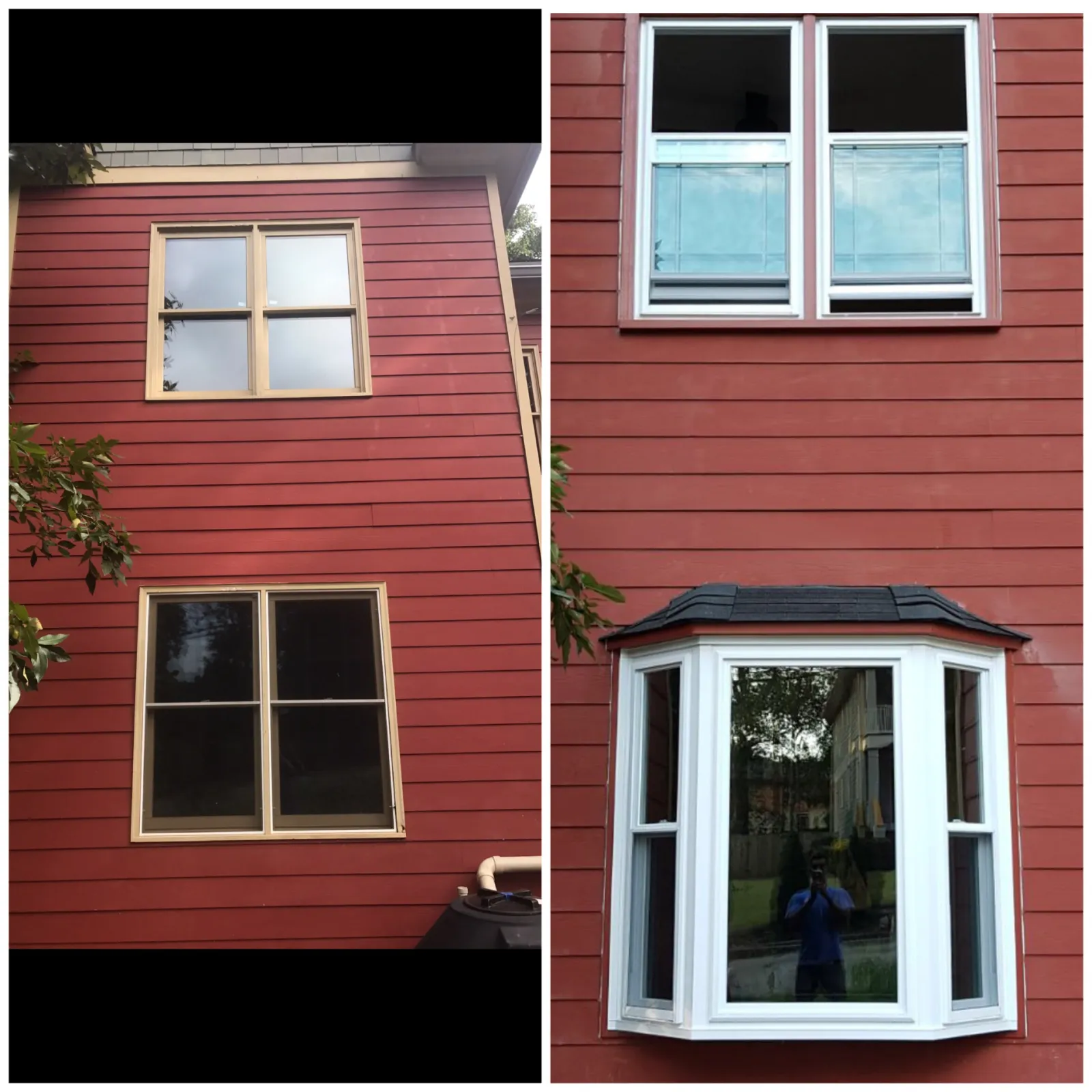
The project in the photo is a red fiber cement home. On the left you see the original condition with tired aluminum clad units and standard flat openings. On the right there are new white windows upstairs and a new bay window with a shingled cap downstairs, tied into the same red siding.
That kind of change looks simple in a photo. On a fiber cement home, it is a detail heavy job, because fiber cement is a rigid cladding that does not stretch, weave or forgive sloppy layout the way vinyl does.
First decision: insert or full frame replacement
Insert or pocket replacement. The new window goes into the existing frame. Nothing outside the frame gets touched, so siding and trim stay put. It is faster, cheaper and cleaner, and it is the right call when the existing frame and sill are dry and structurally sound. You lose a small amount of glass area to the added frame.
Full frame replacement. Everything comes out down to the rough opening. This is required when the frame or sill is rotted, when the original flashing has failed, when you are changing the size of the opening, or when you want to correct a chronic leak. On a full frame job, siding and trim around the opening come off and go back on, so the tie-in matters.
We probe the existing sills and jambs with a screwdriver before recommending either. Putting a new window into a rotted frame is a very expensive way to postpone a repair, and it voids the value of the new unit's warranty in practice because water keeps arriving.
The flashing, in order
Fiber cement is a drained cladding. Water gets behind it. The wall stays dry because the weather barrier and flashing send that water back out. So the order is:
- 1.Sill pan or flexible flashing across the rough opening sill, turned up at the sides so any water that reaches it drains outward.
- 2.Set and fasten the window, level and plumb, shimmed at the load points.
- 3.Side flashing lapped so it goes under the housewrap above and over the wrap below.
- 4.Head flashing with an end dam, installed over the head trim and under the wrap, so water sheds out over the siding face.
- 5.Sealant only where sealant belongs. The bottom stays open so the assembly can weep.
If a contractor's plan for keeping your window dry is a tube of caulk at the perimeter, that plan has a five to ten year clock on it.
The siding tie-in, which is what you will actually look at
Fiber cement cannot be woven like vinyl. Courses have to be cut, and cut lines have to land where they look intentional. On our jobs:
- We remove full courses rather than partial pieces where we can, so joints do not stack up next to the window.
- Every butt joint gets flashing behind it. This is the single most skipped detail in North Georgia siding work. Caulking a butt joint is not a substitute.
- Every field cut gets sealed with primer, including the back side of the cut edge.
- Nailing follows the manufacturer's blind nailing pattern and clearances, because fiber cement fastened wrong cracks at the fastener and telegraphs later.
- Clearances at the roof cap, deck and grade are maintained. Fiber cement sitting tight against a shingle or a deck board will wick.
Our standard practice on all fiber cement siding work in Buford, Lawrenceville and Sugar Hill is the same whether it is a whole house or four courses around one window.
Color matching, honestly
This is where expectations need to be set before the job. If your siding is a current factory finished color, we order matching pieces and you will not be able to find the repair. If it is a discontinued color, or field painted and sun faded for fifteen years, no patch will match. Your options:
- Repaint the affected elevation. Usually the best value, and it refreshes the whole wall. Our exterior painting crews handle it in the same project.
- Design the transition. Wrap the new bay in trim boards so the color break lands on a trim line and reads as a design choice.
- Repaint the whole house. Right answer if the body color is dated anyway.
Adding a bay window while the wall is open
On the project pictured, the homeowner added a bay on the lower level during the window replacement. That is exactly the right sequencing, because a bay requires:
- A new header and framing for the wider opening.
- A support platform and brackets tied into structure.
- A small roof cap, sheathed, underlaid and shingled by our roofing crew to match the main roof.
- Siding and trim tie-in on all three faces.
Every one of those steps overlaps with work already happening. Doing it later means paying for mobilization, siding removal and paint a second time.
What this does for your energy bill and your comfort
Homeowners in Gwinnett County who replace 1990s aluminum clad or single pane units with modern double pane low E glass typically notice three things before they notice a bill change: the rooms on the west side stop being unbearable at 5 pm, road and neighborhood noise drops, and drafts near the glass in January disappear. Combined with insulated vinyl siding or properly installed fiber cement over a continuous weather barrier, the envelope performs like a much newer house.
Buford specifics
Buford, Sugar Hill and the Lake Lanier corridor have a lot of homes in the fifteen to thirty year range with original builder windows now reaching the end of their seal life. The tell is fogging or a haze between panes that will not clean off, which means the insulated glass seal has failed. Fogged units cannot be repaired economically, and they are usually a whole house condition rather than a single window.
Working with EZY Exteriors
Family owned, licensed and insured, over twenty five years across North Georgia. Written scope before we start, photos of the flashing before it is covered, daily cleanup, a workmanship warranty on top of manufacturer coverage, and financing available.
If your windows are fogging or your fiber cement siding needs work around them, request a written estimate and we will walk every opening with you.