Roof decking replacement and shingle repair
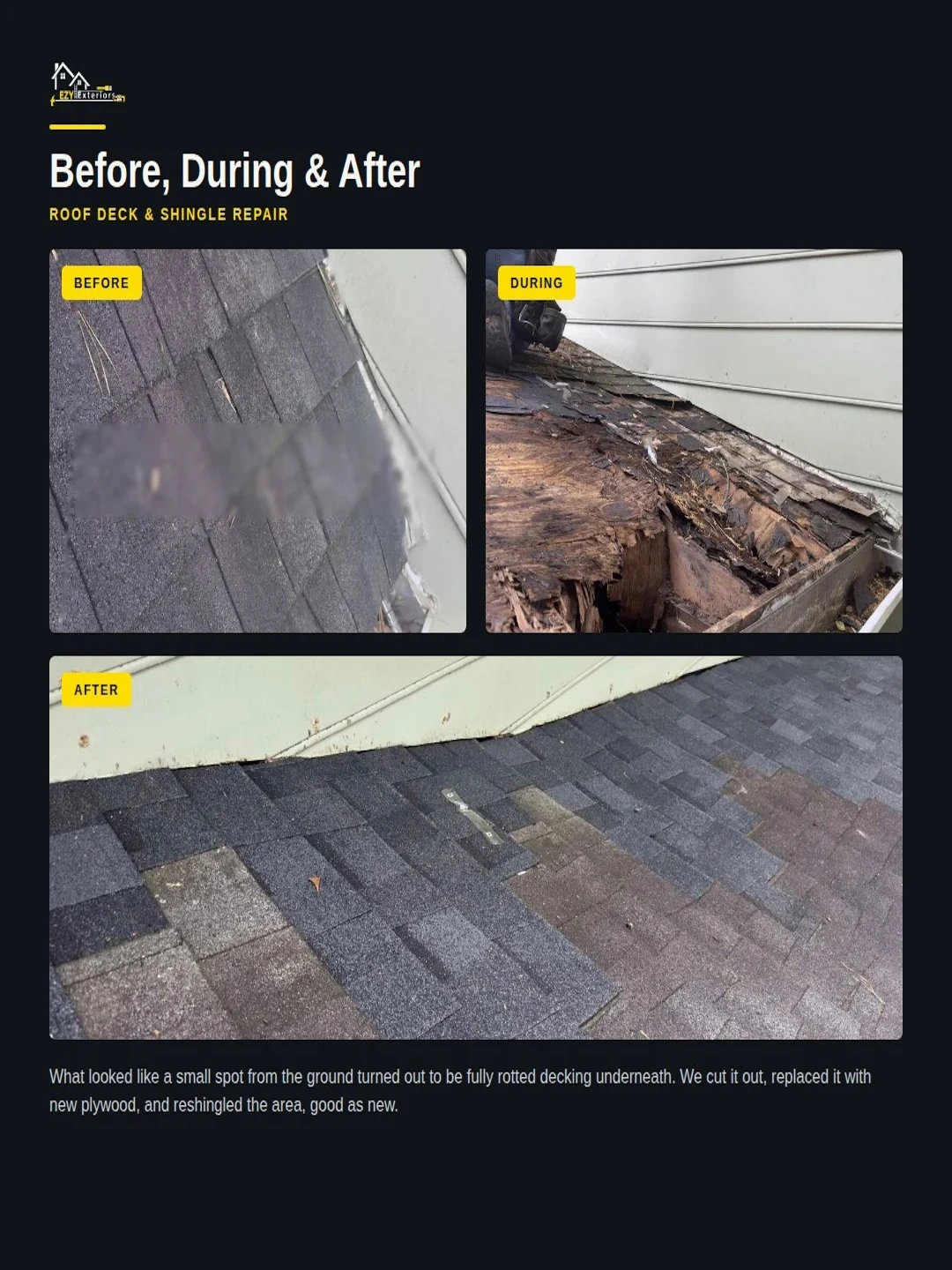
The before, during and after comparison documents a localized roof decking and shingle repair. The work-in-progress view shows the opened roof area, while the completed view shows the repaired section covered with shingles.
The comparison photographs
These images show the affected area at different stages of the work. They document a section repair rather than a replacement of the entire roof. A roof's repair needs should be assessed individually; this photo sequence does not establish the cause or duration of the damage. The during view is the informative one: it shows the roof opened down to the decking, which is the only way to see what is actually happening under the shingles.
What roof decking does
The decking — usually plywood or OSB sheets — is the structural skin of the roof. Shingles and underlayment keep water off it, and the decking carries them. When water gets past the surface, the decking is what gets wet, and wood that stays wet softens and rots. Rotted decking cannot hold fasteners, so shingles over it loosen, and the problem compounds. The only reliable fix is to open the area, remove the damaged sheets, and install new decking before the surface is rebuilt — the sequence this comparison documents.
How decking damage is found
Soft or sagging spots felt underfoot, stains on the underside of the roof in the attic, and recurring leaks in one area are the usual signs. Often the true extent only becomes clear when the shingles come off, which is why a section repair can grow once the roof is opened — the damaged area is measured by what is actually soft, not by what is visible from above.
Roof repair in the Atlanta area
EZY Exteriors handles localized roof repairs like this one as well as full roof replacement across metro Atlanta and northeast Georgia. Read about our roofing services, browse other projects, or contact us about your roof. Free estimates are for homeowners on work they plan to have done.
Repair or replace: the honest calculation
When decking damage is found, homeowners naturally ask whether the whole roof needs to go. The answer depends on extent and age. A localized repair like the one documented here makes sense when the damage is contained and the surrounding roof has years of life left. When damage is widespread, or the shingles are already near the end of their service life, putting repair money into a failing roof is harder to justify. The assessment that matters happens on the roof and in the attic — soft spots underfoot, staining on the underside of the deck, and the condition of the shingles together tell the real story.
Preventing decking damage
Decking rots because water reaches it and stays. The usual routes are failed flashing, failed pipe boots, missing or damaged shingles, and ventilation problems that let attic moisture condense on the underside of the deck. Most of these are inexpensive to fix when caught early, which is why periodic roof and attic checks are worth the trouble. A roof that is looked at every year or two rarely surprises its owner; a roof that is ignored eventually does.
Related services
Roof repairs pair naturally with seamless gutters to manage runoff, and with siding or painting when the wider exterior needs attention. Browse more completed projects, read recent articles, or see the service areas we cover.
What the during photograph tells you
Of the three images in this comparison, the middle one is the most instructive. An opened roof shows the layers a homeowner never sees: shingles, underlayment and the decking beneath. When a contractor opens a roof and photographs what is there before covering it again, that documentation matters — it is the record of what was actually found and what was actually replaced. Homeowners having roof work done should always ask for photographs of any decking work before the new surface goes on, because once the shingles are down, the decking is invisible again for the life of the roof.
Getting a roof looked at
If your roof has a persistent leak, a soft spot, or a section that has been patched more than once, an on-roof assessment will show whether a localized repair like this one is the right scope. EZY Exteriors handles roof repair and replacement across the Atlanta area. Browse other projects, read recent articles, or contact us about your roof. Free estimates are for homeowners on work they plan to have done.
The value of documentation
One lesson this before-during-after sequence offers any homeowner: ask for photographs of work that will be covered up. Roofing, decking, flashing and housewrap all disappear behind finished surfaces, and the only lasting record of what was found and fixed is the pictures taken while the area was open. A contractor who documents the middle stage of the work, as in this comparison, gives the owner proof of what was done — useful for peace of mind, for future buyers, and for any insurance conversation that comes later.
Working with a local roofing contractor
Roofing is a trade where local experience shows. A contractor who works across the Atlanta area every week knows what the local climate does to roofs — which details fail first, which repairs hold, and when a repair stops making sense. EZY Exteriors handles roof repair and replacement across the region, and section repairs like this one are a regular part of that work. If your roof has a problem area, contact us to schedule an assessment, or browse other projects to see more completed work. Free estimates are for homeowners on work they plan to have done.
Project photos