
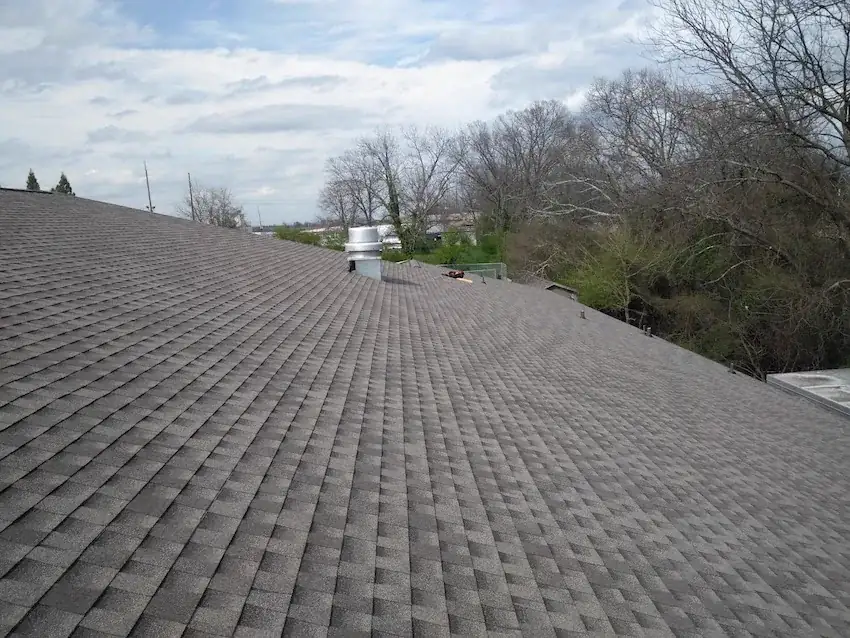
Homes we work on in Dunwoody
Most of Dunwoody was built between the late 1960s and the late 1980s, and that single fact explains almost everything we see here. Neighborhoods like Dunwoody Club Forest, Branches, Wyntercreek and Kingsley are full of two-story traditional homes with brick fronts and wood or hardboard siding on the sides and rear, cedar shake accents, and second and third generation roofs.
When a home in that vintage reaches its third roof, the original hardboard is usually swelling at the bottom edges, the cedar accents are cupping, and the gutters have been patched more than once. That is why so many Dunwoody projects end up combining roofing, siding and gutters. Doing them together is cheaper and produces a better result, because flashing, drip edge, siding termination and gutter lines all interact at the same points on the house.
Roof replacement in Dunwoody
We replace a lot of Dunwoody roofs, and the pattern is consistent: steep front-facing gables, a couple of dormers, chimney flashing that was never properly counterflashed, and attic ventilation that was undersized when the house was built. We tear off to the deck, replace any rotted sheathing, install synthetic underlayment, membrane the valleys and penetrations, install a continuous ridge vent with adequate soffit intake, and finish with architectural shingles from GAF or Owens Corning.
After a North Atlanta hail event we get a lot of calls, and we are straightforward about it: if your roof has real damage we will document it with photos and measurements for your claim, and if it does not, we will tell you that too rather than pushing a replacement. Full detail is on our roofing page.
Siding replacement in Dunwoody
Hardboard and masonite siding was standard on Dunwoody homes in the 1980s and it has now failed nearly everywhere. It absorbs water at the bottom course, swells, delaminates and takes paint poorly no matter how much prep you do. The long-term fix is James Hardie fiber cement, which we install with a proper weather barrier, correct clearance above roof lines and grade, and flashed window and door openings.
Where budget is the priority, insulated vinyl siding is a legitimate option on the sides and rear of a brick-front Dunwoody home, and we will quote both so you can compare. We also replace cedar shake accent gables with fiber cement shake panels that keep the traditional look without the rot and carpenter bee damage.
Exterior painting in Dunwoody
On brick-front homes the painting scope is trim, soffit, fascia, shutters, garage doors and the siding on the remaining elevations. That work lives or dies on prep. We scrape and sand failing areas, replace rot rather than caulking over it, prime bare wood, and use quality exterior acrylics rated for Georgia sun. Details are on our painting page.
Gutters and gutter guards
Dunwoody's tree cover means gutters fill fast. Original 5-inch gutters on a home with a large roof area simply cannot move the volume in a Georgia thunderstorm, and the overflow runs behind the fascia and rots it. We form seamless 5-inch and 6-inch aluminum gutters on site, replace rotted fascia before hanging, and offer guard systems for homeowners tired of climbing ladders twice a year.
Permits, HOAs and neighborhood expectations
The City of Dunwoody handles its own permitting, and most established Dunwoody subdivisions have an active HOA with color and material standards. We take care of permits and provide the documentation your association needs. Crews park considerately, protect landscaping, keep the driveway clear at the end of each day and magnet-sweep for nails.
Why Dunwoody homeowners hire us
We are a Lawrenceville-based, family-run company with more than 25 years of exterior experience. We use crews we know instead of whoever is available, we put everything in writing, and we send photos of what we find rather than asking you to take our word for it. Free estimates, honest recommendations and financing options are all part of it.
Timing an exterior project in Dunwoody
Dunwoody's calendar is driven by storms and HOA cycles. Spring hail and wind push roofing demand hard from March through June, so a homeowner who gets inspected in January or February usually gets to pick a start date. Siding work runs almost year round, while exterior painting turns out best in spring and fall when surfaces are not baking at midday.
What working with us looks like
We start with an on-site inspection: measurements, photos of every problem area, and an attic check where there is access. You get a written scope naming the exact shingle or siding line, the flashing and ventilation work included, cleanup terms and warranty coverage. Where two approaches make sense on a Dunwoody home, such as fiber cement versus insulated vinyl on the rear elevations, you get both prices to compare.
On the job you deal with one point of contact. Material is delivered right before the start, the driveway stays usable, plantings near the work are covered, and we haul debris and magnet-sweep every evening rather than only at the end. When the work is done we walk it with you and fix anything on the punch list before invoicing. We also leave you the manufacturer documentation your HOA or a future buyer may ask for.